How to write a 30-second commercial script
Hook, message, call to action: the six beats of a 30-second commercial with timings, a two-column script you can copy, and the facts you're allowed to use.
Thirty seconds is the standard length of a commercial, and it is shorter than it sounds. Here is how to write one: what fits, the six beats with their timings, a two-column script you can copy, the facts you are allowed to put on screen, and how the script becomes a storyboard (the shot-by-shot plan with a picture for each shot). This is the structure our storyboards follow; the AI commercials page shows how the script turns into a finished ad.
What 30 seconds holds
People speak about 2.5 words a second. That gives a 30-second spot (ad people's word for one ad) room for about 70 spoken words, and that is if someone talks the whole time, which feels rushed. Aim lower and leave gaps for the pictures and the music.
Pictures move faster than words. Ads have cut quickly for decades: a study of US TV ads from 1978 to 1991 found the average shot was under two seconds by the end of that period. A good 30-second commercial today usually has 10 to 15 shots, each 2 to 3 seconds, with a product shot that holds a little longer. Those counts are practice, not a rule, but they are a good check: if your script needs 25 shots or 4, something is off.
The one-message rule
Agencies insist on a single-minded message: one thing the viewer must remember. An ad with three messages lands none, because the viewer is scrolling, cooking or half-watching. Write the one thing in a sentence before you write anything else. Everything in the script either serves it or goes.
The six beats with timings
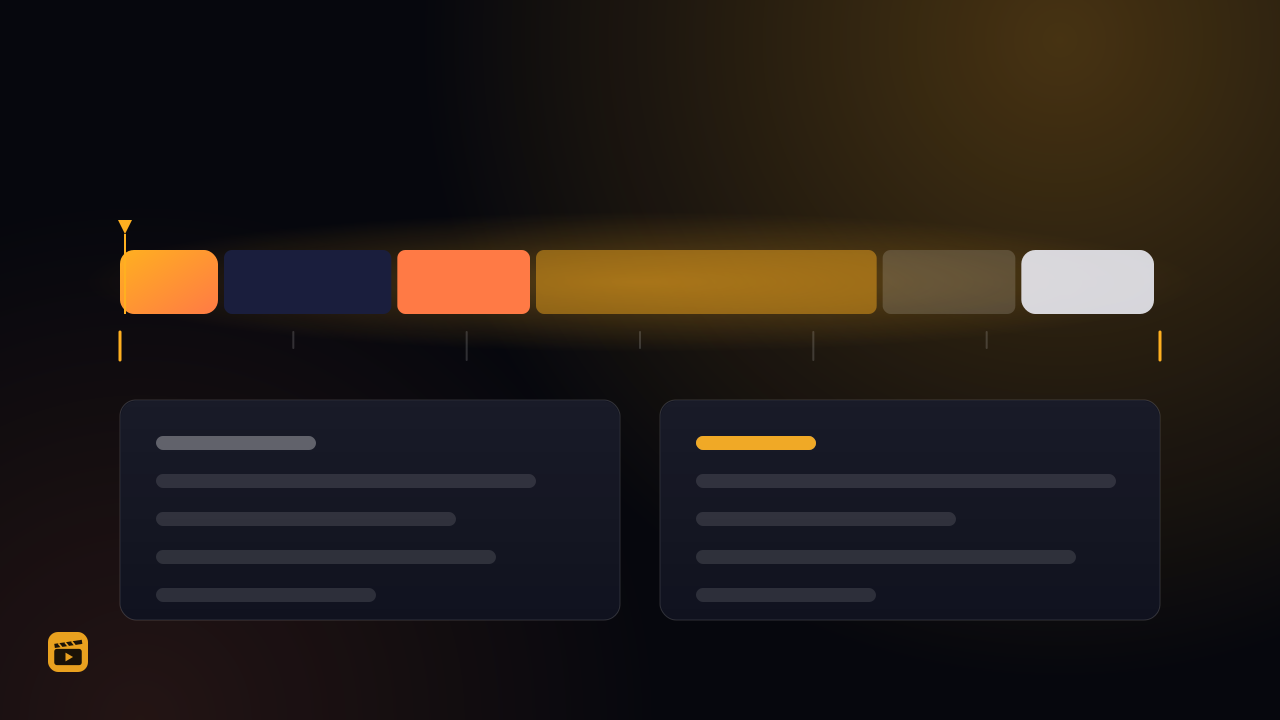
Most good 30-second commercials follow six beats. The timings are practice, drawn from how agencies and platforms describe the shape of an ad, not a law.
- Hook, 0 to 3 seconds. The hook is the first two or three seconds that make someone stop scrolling or keep watching: a problem moment, a surprising picture or a bold question.
- Problem, 3 to 8 seconds. Two shots of the pain, without naming the product yet.
- Meet the product, 8 to 12 seconds. The turn. The product appears big and close with its name on screen.
- How it helps, 12 to 22 seconds. Three or four shots of the product doing its job, with one or two short callouts (a few words of text pointing at a feature).
- Proof, 22 to 26 seconds. One thing that makes the claim believable: a number, a quote, a rating. Only if you have it.
- Call to action and end card, 26 to 30 seconds. The call to action is what you ask people to do, in exact words. The end card is the last screen with your logo, those words and your web address.
Google's guidance for YouTube ads asks for the brand within the first five seconds. If your hook is strong enough, the product can appear earlier than beat three; the order is a default, not a cage.
Write the hook first
Start with the hook, because it decides whether the other 27 seconds get watched. Three shapes work most often: a problem moment (the thing your customer hates, shown, not described), a surprising picture (something the eye cannot place for a second), or a bold question, short and on screen as well as spoken, because many people watch with the sound off. Write five hooks and keep the one you would stop for. Our post on video ad hooks goes through seven types with examples.
The two-column script
Agencies write scripts in two columns: the picture on the left, the sound on the right, beat by beat. Here is a full example for Brightdesk, a product we made up for this post (there is no Brightdesk; its numbers are invented, and yours must be real).
| Beat and time | Picture | Sound |
|---|---|---|
| Hook, 0 to 3 s | Extreme close-up of a desk buried in sticky notes; a fast push-in (the camera moving quickly closer) | Paper rustles. Voice: "Forty-one tabs. Three to-do apps. One brain." |
| Problem, 3 to 8 s | A person at a laptop, scrolling, then a close-up of a calendar alert they missed | Voice: "You don't need another app. You need one place that remembers for you." |
| Meet the product, 8 to 12 s | The Brightdesk screen on a laptop, revealed as the camera pulls back; the name appears on screen | Music lifts. Voice: "Meet Brightdesk." |
| How it helps, 12 to 22 s | Three shots: a task typed and sorted; a reminder arriving on a phone; a cleared screen at the end of the day. Callout: "Reminds you. Clears it." | Voice: "Type a task. Brightdesk files it, reminds you, and clears it when it's done." |
| Proof, 22 to 26 s | A simple card: "12,000 teams start their day here" (an invented number) | Voice: "Twelve thousand teams start their day here." |
| Call to action, 26 to 30 s | The product big and close with a slow push-in, then the end card: logo, "Start free at brightdesk.com" | Voice: "Start free at brightdesk.com." A short musical sting. |
That is 49 spoken words, about 20 seconds of talking in a 30-second ad, which leaves room for the pictures to do their part. Count the shots: ten. Count the messages: one.
Proof you're allowed to use
The proof beat is where scripts get companies into trouble. The rule is simple: only facts you have. A rating you can show, a number from your own data, a quote from a real customer who agreed to be quoted. Never a number you cannot back. If you have no proof yet, skip the beat and give the time to the product. An honest 30 seconds beats a padded one. At customcommercials.ai the storyboard writer is told to use only the facts in your brief (read every line before you approve), which is one more reason to write the brief with care.
The call to action
Say exactly what to do and exactly where to go. "Start free at brightdesk.com" works. "Learn more" does not, because it asks for nothing. Put the same words on the end card and in the voice, and keep the web address short enough to remember after one hearing. For local TV, say the phone number or the town. For an app, name the store. One action, not a menu.
Read it aloud with a timer
Read the right-hand column out loud at a normal pace with a stopwatch running. If it takes more than about 22 seconds, cut words, not shots. Then listen for anything that sounds written rather than said. Contractions are allowed. Jargon is not.
Cut-downs: a 15 and a 6 are built, not trimmed
A cut-down is a shorter version of the same ad. You cannot trim a 30 into a good 15, because the beats do not shrink evenly. A 15-second social ad keeps the hook, a one-shot problem, the product reveal, two quick shots of it working and the offer. A 6-second bumper (an ad viewers cannot skip) is three shots: the product up close, one benefit in three to five words, the logo and the call to action. Write each one fresh on its own two columns. Our video ads page covers the short formats, and the TV commercials page covers what a 30 needs for local TV and streaming.
Turn the script into a storyboard
A script says what happens. A storyboard says what it looks like: for each shot, its size (extreme close-up, close-up, medium, wide), its camera move (a push-in, a pull-out, an orbit, a static frame), the line said over it, the text on screen, and a picture of the shot. The picture is the part that catches mistakes, because a line that reads fine can describe a shot that looks wrong.
At customcommercials.ai the storyboard is written from your brief with a preview still (one picture of what the shot will look like) for most shots, and it costs nothing. Change any line or shot before you approve it, and see the exact price for the finished length first.
FAQ
How many words fit in a 30-second commercial?
About 70 if someone talks the whole time, at the usual pace of 2.5 words a second. Most good 30-second spots use fewer, around 45 to 60, and leave gaps for the pictures and the music. If the words take more than about 22 seconds to read aloud, cut words.
What are the parts of a commercial script?
Six beats: a hook in the first three seconds, the problem, meeting the product with its name on screen, how it helps in three or four shots, one piece of proof, and the call to action on an end card. Write it in two columns, picture on the left and sound on the right.
How do you write a hook?
Show a problem moment, a surprising picture or a bold question in the first two or three seconds, and make it work with the sound off, because many people watch muted. Write five and keep the one you would stop for yourself.
Should the brand name come first?
Not always, but early. Google's guidance for YouTube ads asks for the brand within the first five seconds, and TikTok asks for the proposition in the first three. A strong hook can run first as long as the product shows up by about the eighth second and again before the end card.
What is a call to action in a commercial?
The exact words that tell the viewer what to do and where to go, such as "Start free at brightdesk.com," spoken at the end and shown on the end card with the logo. One action, in plain words, with an address short enough to remember after one hearing.
Sources
- The six beats, shot counts and 2.5 words a second are industry practice drawn from script guides for creator-style ads (https://motionapp.com/blog/how-to-write-ugc-ad-scripts and https://useclip.com/ugc-script-templates-for-5-ad-types), Google's ABCD guidance and TikTok's creative guidance, not a platform rule.
- MacLachlan and Logan, camera shot length in TV commercials, a study of US TV ads from 1978 to 1991 (abstract): https://www.warc.com/Content/421e1376-baa5-472f-aa9d-adc58bea5146
- Google, creative best practices for YouTube ads: https://business.google.com/us/think/future-of-marketing/creative-best-practices-youtube-ads/
- TikTok, creative best practices for performance ads: https://ads.tiktok.com/help/article/creative-best-practices?lang=en
- StudioBinder on shot lists, for the storyboard fields: https://www.studiobinder.com/blog/shot-lists
Questions about this post or about customcommercials.ai? Contact us or email support@customcommercials.ai.